My try to model present-day Swedes was not what I hoped, because lack of proper western Iron Age samples. Now I tried to find out the best possible solution using Scania_IA and older samples. I noticed that in all possible variations we need recently unavailable and unknown Iron Age samples to achieve reasonable results. So I have to forget such tests until West European Iron Age samples are available. Several Central European Late Copper Age samples turned out to be best ones, but made not proper fits, for instance:
Scania_IA Protoboleraz_LCA
best coefficients: 0.949 0.051
Jackknife mean: 0.947619305 0.052380695
std. errors: 0.041 0.041
This is best I can do right now.
An issue beyond qpAdm is how to determine standard errors. While we can consider low standard error good, there is also a good reason to consider high standard error reasonable in many cases. In a case where two or more populations share pretty much common ancestry (as it is in many case today) qpAdm can't determine which one is the right one. For instance in a case of admixtures built of Swedes and Norwegians the standard error can be very high, because qpAdm is not able to break ancestries into common ancestry of both populations. So, when we try to minimize the standard error we in fact abandon the most obvious result. Usually this dilemma is tried to avoid in two ways: 1) using very ancient/distant samples to avoid common ancestry or 2) approving very high chisq and small tail prob values. In the latter case we actually approve poorer results to show falsely better results.
A result showing high standard errors:
Estonians:
Scania_IA Baltic_IA Poland_BA
best coefficients: 0.560 0.108 0.332
Jackknife mean: 0.253950408 0.349222728 0.396826864
std. errors: 0.532 0.634 0.389
In this case all admixtures are overlapping resulting statistical transitions and uncertainty between admixtures and high standard errors, but chisq and tail prob values are still relatively good, respectively 2.290 and 0.942093.
Another case shows low standard errors, but poorer coverage of admixtures:
Swedes:
Scania_IA Hungary_LCA
best coefficients: 0.948 0.052
Jackknife mean: 0.946235880 0.053764120
std. errors: 0.043 0.043
Respectively chisq and tail prob values were 7.413 and 0.492767.
I can make a more provocative latter example for similar target populations in which standard errors could be 1-2 percentages and chisq and tail prob values around 10-20 and 0.1-0.2
tiistai 18. joulukuuta 2018

maanantai 10. joulukuuta 2018
Finnish genetic composition: Iron Age Baltic, Iron Age Germanic and probably Iron Age Saami people
You probably have read my previous post regarding European genetic structures composed by Admixture and Eurasian data. My aim was to make an admixture analysis free of recent genetic drift. It gave following admixtures for Southwestern Finns (Finnish, k=10)
- Saami 14%
- Baltic 49%
- Germanic 35%
The post is here.
Now I have tested same admixtures using Iron Age samples and qpAdm. QpAdm allocates admixtures for given populations, in these tests admixture populations were Baltic Iron Age, Scanian Iron Age and Levaluhta Iron Age. Levaluhta consists of five Iron Age remains found from Finnish Bothnia, Ostrobothnia. The id of the Scanian IA sample is RISE174 and the Baltic IA sample is DA171. Although my results are unambiguous, there are some uncertainty regarding the software and given references, and being the first exploring something like this I am curious to see results of professional geneticists. I simply can't understand why this matter wouldn't interest also researchers. All samples I use here are publicly available.
Southwest Finns:
chisq tail prob
1.112 0.992818
Levaluhta 0.115
Scania_IA 0.437
Baltic_IA 0.448
Vepsa:
chisq tail prob
1.555 0.980354
Levaluhta 0.202
FIN_Southwest 0.614
Baltic_IA 0.184
Nganasan -0.000
and another result of Vepsa
chisq tail prob
2.734 0.908488
Levaluhta 0.000
FIN_Southwest 0.764
Baltic_IA 0.164
Nganasan 0.072
The match is much worse when using present-day Baltic, Germanic and Saami counterparts.
Southwest Finns:
chisq tail prob
9.270 0.233881
Saami 0.156
Latvian 0.297
Swedish 0.548
Outgroups and coverages were
Kostenki14 813405
MA1 625746
WHG 703903
Iron_Gates_HG 884901
EHG 983976
CHG 889688
Ganj_Dareh_N 794892
West_Siberia_N 670626
Anatolia_Neolithic 889986
LBK_EN 880957
Typical SNP coverage of target groups
Vepsa1M 971774
Levaluhta 377788
FIN-Southwest 1102712
Baltic_IA 97311
Scania_IA 373352
Nganasan1M 971774
I have lost some SNP's due to allele mismatches or multiallelic conversion errors in Plink, but the coverage is still reasonable. Some ancient samples need to be reconverted.
edit 11.12.2018 16:30
Adding Russians from Pinega makes a perfect match for Vepsas. Not a big surprise.
chisq tail prob
0.825 0.991377
FIN-Southwest 0.672
RusPinega 0.130
Baltic_IA 0.093
Levaluhta 0.105
tiistai 4. joulukuuta 2018
Finnish and North Russian ancestries derived from Levaluhta and Bolshoy Oleni Ostrov
Unfortunately the Lamnidis et al. 2018 did not test the origin of the Siberian ancestry in present-day Finns and Russians. I reveal it now. Ancient samples found from Bolshoy gives high F3-results for both groups. I included five Finnish groups, three of my own sample selection and two smaller selections from two academic sources.
FinnMostCW - least drifted Finnish group (- outliers)
FinnLocal - most drifted Finnish group (- outliers)
Finn21M - most Scandinavian group (- outliers)
Both academic Finnish groups look incoherent. I wonder why.
It is obvious that the Levaluhta admixture added to the present-day European backbone in Finns (negative F3-values) doesn't explain all non-Europeanness and there have to be an unknown third component.
Source1, source2, target, f_3, std.err, Z and SNP count

Additionally, here are resultw of my old admixture analysis based on Dna.Land's program. Although it sounds a weird idea to make admixture analysis of ancient samples using present-day populations, it is a normal practice in many academic studies. Studies usually use Nganasans to represent Siberians together with ancient samples. It is reasonable to say that the gene flow can be detected also backwards. It is also very likely that the gene flow between contemporary populations has been bidirectional. Nevertheless, I am not fully convinced about the gene flow direction regarding the European side of Finns and Northern Russians. F3-statistics gave several European candidates and the big picture is more complex.
Levaluhta (JK excluding JK2065 outlier)
Finnic 43,7
Saami 30,0
Uralic 12,1
Siberian 9,5
Baltic 2,2
East_Asian 1,9
Bolshoy
Uralic 38.9
Siberian 29.5
Saami 11.6
Finnic 7.1
East_Asian 6.1
Northeast_European 5.4
Baltic 1.5
keskiviikko 28. marraskuuta 2018
New study tells about the Siberian origin, but not yet about the Finns
Finally, the new study about the Siberian origin in Finland is published. It is however too early to say where the Finns came from, or even speculate on it, because the study includes no samples from the settlement areas of ancient (prehistoric) Finns or from areas where they according scientists came from. Rumors tell that researchers have Iron Age samples also from the Southwest Finland, but we have still to wait to see it. The data is not yet available, but I'll be online soon after I have them.
sunnuntai 25. marraskuuta 2018
Perspectives using traditional unsupervised admixture analysis
Trying to border us closer on our reality and on the side of believable I have done the following series of Admixture analyses using samples of living Eurasian populations. My database consists of 0.5 million SNP's over the world, but to minimize the effect of recent genetic drift I made a LD pruning operation decreasing the amount of SNP's to 125 kSNP's. Without that many isolated sample groups would hijack the analysis and turn the history backward. But there are many kinds of genetically isolated populations; the Basques are not a young isolation. Conversely in large areas in the North Europe and in the North Asia many populations are very young and they can make the history really backward in genetic tests. Those small northern, not so long ago diverged groups, were hunter-gatherers or nomads without borders. Once western or eastern civilizations with text books appeared to the neighborhood they were localized and they we named. This happened only a few hundreds years ago. No one really know where they lived and where they came from THOUSANDS years ago.
This post just to remind about the present-day reality after hypocrite uniparental speculations about our ancestry seen on the internet and in popular science. The command line was
$admixture1.3 data.bed n -j4 -B
where n is 9-15 and 20 (20 only in numeric data) .
You can repeat this test with your own data and post results here. Remember to carry out LD-pruning to get rid of the misleading recent genetic drift.
The data includes 560 individual, 20 samples at its peak in each group. I computed group averages to make the results more easy to read. The data behind bars can be downloaded here.
Be aware of the bar colors, because I had not nerve to arrange colors manually and automated "R barplot" coloring was not a bullet proof solution and same colors exist repeatedly with several k values. You can check the result using downloaded data.


tiistai 6. marraskuuta 2018
Mongolian or not Mongolian
I already promised to stop my IBD rant, but it did happen that a new Chinese study provoked me to do a little more. This new study is here and here. The figure below shows shared IBD segments of 1-2 cM and the ratio between shared segments of Evenks and Mongolians. If the ratio is high then the Evenk admixture is more likely than the Mongolian one. If the ratio is low, but over 1, we go closer the Mongolian probability, but the Evenks IBD (Siberians) can act like a proxy for Mongolians. Ratios below 1 means that the Mongolian admixture is more likely than the Evenk (Siberian) one.


perjantai 2. marraskuuta 2018
Pskov Russia, the connection between Finnic groups
This will be my last IBD test for a while, because IBD itself is not a good method for seeking oldest ancestral linkages. It is still a good statistic method manifesting events of the Iron Age and the genealogical time frame. It is excellent in seeking real ancestral linkages in the before mentioned time-period and can be preferred instead of any method using allele data, such as PCA, DSTAT etc., because all those methods imply only genetic distance and genetic distance depends on the admixture itself. Using allele statistic in seeking the origin of mixed populations is always misleading. You can only suggest that your hypotheses are right or wrong and continue testing using different variations to increase the probability.
Here I present some IBD results of both Finnic and Russian populations using Beagle version 5. The linkage between all Finnic people and also between Finnic and Baltic people is notable and turns up in Pskov (in Finnish Pihkova). The Pskov area is also the northernmost place in Russia where I have found autosomal relatives (23andme).
I use again Finnish samples from the 1000 genomes project, but at this time I grouped them using my project members, whose geographic origin is known.


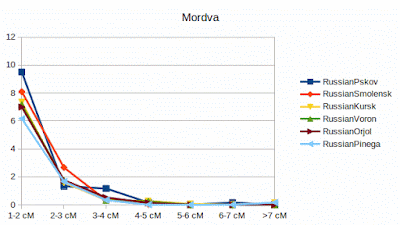
Cross-checking with Pskov is presented below. Notice that there is no Siperian admixture in Pskov. Although people, including most researches, suggest that the Siberian admixture among Finnic people is a common signature of the origin of the FU languages, nothing about it is proven. The Siberian admixture in Finland is dated to the Iron Age by several scientists and research. Still the hypothesis of the present day Siberian admixture in Finland and the origin of the language (FU urheimat theories) is usually thought to be proven! The IBD connection between Finns and North Russian is two-fold; at first the Finnish Iron Age migration to Russia and secondly the common Siberian admixture which is quite new. This kind of Iron Age Siberian migration/admixture doesn't exist between Finns and people in Pskov and we have no evidence about migrations from Finland to Pskov. Instead of this, we have clear and undeniable linguistic evidences about Finnish eastern migrations to the Northwestern Russia, at least to the area of the lake Onega! The primary conclusion have to be that the Pskov area had a pre-Iron Age connection with Finnic people, including the Finns. It must have happened before the Siberian admixture in Finland and before the Finnish eastern migration.


Russian results do not give an observation of any distinct ancestry from the Pskov area and only the northernmost Russians show some divergence from the Russian resemblance.


Here I present some IBD results of both Finnic and Russian populations using Beagle version 5. The linkage between all Finnic people and also between Finnic and Baltic people is notable and turns up in Pskov (in Finnish Pihkova). The Pskov area is also the northernmost place in Russia where I have found autosomal relatives (23andme).
I use again Finnish samples from the 1000 genomes project, but at this time I grouped them using my project members, whose geographic origin is known.


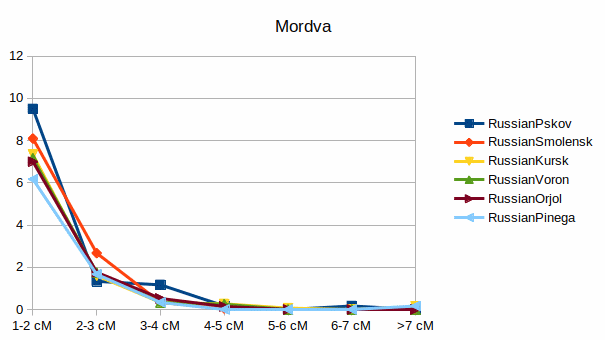
Cross-checking with Pskov is presented below. Notice that there is no Siperian admixture in Pskov. Although people, including most researches, suggest that the Siberian admixture among Finnic people is a common signature of the origin of the FU languages, nothing about it is proven. The Siberian admixture in Finland is dated to the Iron Age by several scientists and research. Still the hypothesis of the present day Siberian admixture in Finland and the origin of the language (FU urheimat theories) is usually thought to be proven! The IBD connection between Finns and North Russian is two-fold; at first the Finnish Iron Age migration to Russia and secondly the common Siberian admixture which is quite new. This kind of Iron Age Siberian migration/admixture doesn't exist between Finns and people in Pskov and we have no evidence about migrations from Finland to Pskov. Instead of this, we have clear and undeniable linguistic evidences about Finnish eastern migrations to the Northwestern Russia, at least to the area of the lake Onega! The primary conclusion have to be that the Pskov area had a pre-Iron Age connection with Finnic people, including the Finns. It must have happened before the Siberian admixture in Finland and before the Finnish eastern migration.


Russian results do not give an observation of any distinct ancestry from the Pskov area and only the northernmost Russians show some divergence from the Russian resemblance.


Tilaa:
Blogitekstit (Atom)
-
 Testing ancient "steppe" samples on PCA together with modern ones revealed unexpected issues. Studies have included different set...
-
The EGDP data, available from Estonian Biocenter, made it possible to reach 15-30 times more genome density than earlier available data made...
-
 This is probably not a popular writing, but I am not a politician and I don't need to please anyone. Here is the issue: why the yDna d...