This will be my last IBD test for a while, because IBD itself is not a good method for seeking oldest ancestral linkages. It is still a good statistic method manifesting events of the Iron Age and the genealogical time frame. It is excellent in seeking real ancestral linkages in the before mentioned time-period and can be preferred instead of any method using allele data, such as PCA, DSTAT etc., because all those methods imply only genetic distance and genetic distance depends on the admixture itself. Using allele statistic in seeking the origin of mixed populations is always misleading. You can only suggest that your hypotheses are right or wrong and continue testing using different variations to increase the probability.
Here I present some IBD results of both Finnic and Russian populations using Beagle version 5. The linkage between all Finnic people and also between Finnic and Baltic people is notable and turns up in Pskov (in Finnish Pihkova). The Pskov area is also the northernmost place in Russia where I have found autosomal relatives (23andme).
I use again Finnish samples from the 1000 genomes project, but at this time I grouped them using my project members, whose geographic origin is known.
Cross-checking with Pskov is presented below. Notice that there is no Siperian admixture in Pskov. Although people, including most researches, suggest that the Siberian admixture among Finnic people is a common signature of the origin of the FU languages, nothing about it is proven. The Siberian admixture in Finland is dated to the Iron Age by several scientists and research. Still the hypothesis of the present day Siberian admixture in Finland and the origin of the language (FU urheimat theories) is usually thought to be proven! The IBD connection between Finns and North Russian is two-fold; at first the Finnish Iron Age migration to Russia and secondly the common Siberian admixture which is quite new. This kind of Iron Age Siberian migration/admixture doesn't exist between Finns and people in Pskov and we have no evidence about migrations from Finland to Pskov. Instead of this, we have clear and undeniable linguistic evidences about Finnish eastern migrations to the Northwestern Russia, at least to the area of the lake Onega! The primary conclusion have to be that the Pskov area had a pre-Iron Age connection with Finnic people, including the Finns. It must have happened before the Siberian admixture in Finland and before the Finnish eastern migration.
Russian results do not give an observation of any distinct ancestry from the Pskov area and only the northernmost Russians show some divergence from the Russian resemblance.
perjantai 2. marraskuuta 2018
keskiviikko 10. lokakuuta 2018
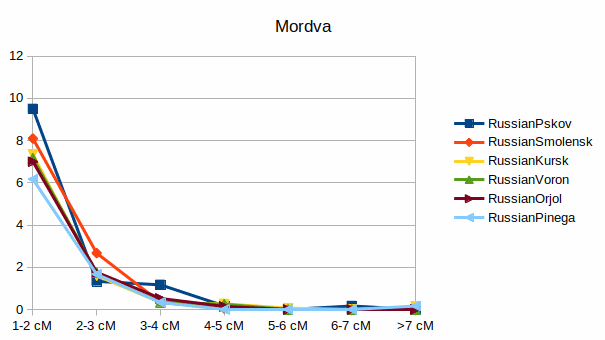
More IBD-statistics, including Mordvas, Brits and Basques
I have now automated the process and can do "quick and dirty" statistics of all below listed populations. Adding new populations takes about two days in a case I have them in my backbone data base. Here are now existing populations and sample counts. Adding new populations to my data base takes longer, around a week.
The results are based on slightly changed phasing parameters, so there can be slight differences in absolute values. Used programs are Plink, Impute2 and Beagle version 5.
sunnuntai 30. syyskuuta 2018
Potential Kyrgyz admixture in Europe, shown using IBD results from Beagle 5
It is well known that during the first millennium the Europe was threatened by invading Mongols called Huns. The Huns themselves were probably not a homogeneous group and were build of many ethnic groups. Later, during the second millennium Europeans, especially Eastern Slavs were threatened by the army of Genghis Khan. Those later rulers were called Tatars. My results show that there is a subtle Mongol admixture in Europe, but amazingly not among present day Tatars. The results are based on the difference of IBD sharing between Nganasans and Kyrgyz. Nganasans are known as an isolated group of Northwest Siberian people, used often to demonstrate Siberian admixture in Europe. My previous test shows that Evens match even better in this purpose, but the distribution of Evens is much larger in Europe, which can be due to the European admixture among Evens, rather than wise versa. So it is better to use more distinct Nganasans in this purpose.
lauantai 29. syyskuuta 2018
Swedish IBD-sharings around the Baltic Sea and a little further
Unfortunately I have not enough German, Danish and Norwegian samples, or the origin is unclear, but here some evidence about the Swedish influence in Finland, or conversely Finnish/Karelian influence in Sweden, if you prefer it. For better or worse, the IBD-sharing is evident on the eastward route. My goal is to add at least some known German samples in the future.
Saami IBD-sharing
Continuing with the same phased data I made two IBD-statistics and compared the Saami (from Finnmark) with Northern Europeans and Siberians. The result shows highest 1-2 cM IBD's between Saamis and Even samples from the SGDP data. So I made a follow-up using SGDP-Evens. I have not detailed information about the origin of those Evens. The curve implies that the connection between Saamis and SGDP-Evens is old but strong.
Notable is also the strong 2-3cM sharing between Saamis and Northern Baltic Finns, including Finns, Karelians, Vepsas and Ingrians. This may be a consequence of the first contact between Saamis and Baltic Finns. Smaller segments are more vague in timing due to the random segment break down and data inaccuracy.
perjantai 28. syyskuuta 2018
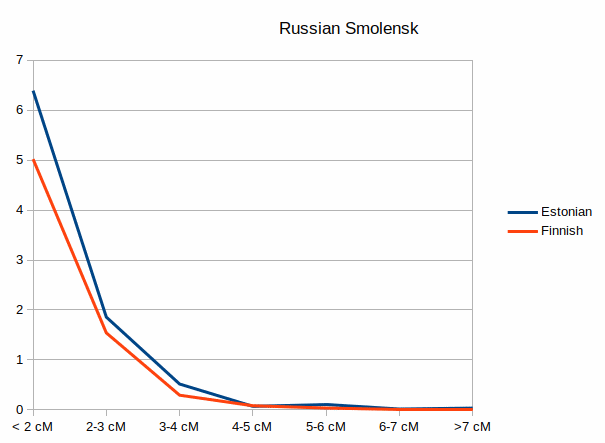
Differences in IBD-sharings between Estonians and Finns
These statistics are based on haploid IBD's made by Beagle 5 and Beagle Refined IBD. The data was partly imputed (IMPUTE2) to increase the SNP amount of some populations from 300 kSNP to 500kSNP, although most samples are from larger data sets. Samples of this IBD-data are listed here, including also sample sizes. Accuracy of results depends on the sample size, although trends are quite reliable anyway, as the following tests show without doubt. I'll continue testing with this data later.
Results show the average IBD-sharing (segments) between single individuals of each population.
(X-axis legends fixed, note that the minimum segment size was 1 cM)
Results show the average IBD-sharing (segments) between single individuals of each population.
(X-axis legends fixed, note that the minimum segment size was 1 cM)
sunnuntai 9. syyskuuta 2018
Sigtuna, Sweden Viking Age
I was lucky to get new samples (ENA bam-files) from the study Genomic and Strontium Isotope Variation Reveal Immigration Patterns in a Viking Age Town, Maja Krzewiska et al. 2018. The study included seven high quality late Viking Age samples from the Swedish town Sigtuna. Sigtuna was an important market place, founded 970 ad and continued to be important to the 13th century. These seven samples are good enough to make admixture analyses. I have made admixture analyses using Dna.Land's software, look here, and I see no reason to change my methods. These samples are only 900-1100 years old and it is reasonable to suggest that modern references are suitable for this purpose, especially because with the modern reference the genome quality is is much better than using other ancient samples as references.
Why admixture analyses, why not tests utilizing genetic drift, like qp3Pop and qpDstat? Both above-mentioned methods or other tests like IBD and IBS statistics, as well as Fst tell genetic distances, not the genome structure, giving often a false image of our ancestry. In spite of weaknesses of admixture analyses in case of really old ancient samples (where no one can really figure the admixture history), in this particular case all samples are only 1000 years old and the link between them and us is significant and the admixture history figurable. Good admixture results only call for two condition to be true: at first the admixture history must be real and references must be right. In many cases these conditions are not fulfilled and people after seeing senselessness start to bark up the wrong tree.
grt036
East_Scandinavian 24.7
Slavic 18.8
Mediterranean 14.3
Northeast_European 14.0
Central_European 11.0
Northwest_European 8.8
Saami 4.4
Baltic 3.3
grt035
Northwest_European 40.8
Central_European 16.7
Mediterranean 14.8
East_Scandinavian 10.8
Saami 9.8
Baltic 5.7
Slavic 1.3
kal006 (this looks like present-day Estonians)
Baltic 54.3
Finnic 20.4
East_Scandinavian 12.8
Northeast_European 9.5
Siberian 2.0
stg021 (this looks like preset-day Swedes)
East_Scandinavian 43.5
Northwest_European 22.9
Mediterranean 12.8
Slavic 6.6
Saami 6.1
Northeast_European 2.5
Uralic 1.3
East_Asian 1.8
Baltic 1.7
84001 (this must be mainly British)
Northwest_European 64.2
Baltic 14.1
Uralic 5.0
Saami 4.7
East_Scandinavian 4.3
Slavic 2.1
Mediterranean 2.3
Finnic 2.8
84005 (a quarter Finn, maybe even more Finnish taking into account the Finnish demographic history after the Viking Age)
East_Scandinavian 39.6
Finnic 24.7
Baltic 13.6
Northwest_European 11.8
Slavic 3.1
Mediterranean 3.0
Central_European 3.6
For a comparison, a project sample of Finnish ancestry from Southwestern Finland:
Finnic 49.1
Northwest_European 25.1
East_Scandinavian 12.9
Northeast_European 5.1
Slavic 2.4
Saami 2.9
Baltic 2.3
urm160
Central_European 33.1
East_Scandinavian 29.9
Slavic 19.1
Finnic 6.8
Baltic 4.5
Uralic 2.9
Saami 1.8
Northwest_European 1.3
It is notable that many Viking Age Swedish samples show Saami without Finnish ancestry. This probably means that the Finnish-Saami mixing was not yet as significant as today. It is also possible that the Saami admixture here means common Swedish-Saami ancestry which is not clearly assignable using modern Saami references.
Why admixture analyses, why not tests utilizing genetic drift, like qp3Pop and qpDstat? Both above-mentioned methods or other tests like IBD and IBS statistics, as well as Fst tell genetic distances, not the genome structure, giving often a false image of our ancestry. In spite of weaknesses of admixture analyses in case of really old ancient samples (where no one can really figure the admixture history), in this particular case all samples are only 1000 years old and the link between them and us is significant and the admixture history figurable. Good admixture results only call for two condition to be true: at first the admixture history must be real and references must be right. In many cases these conditions are not fulfilled and people after seeing senselessness start to bark up the wrong tree.
grt036
East_Scandinavian 24.7
Slavic 18.8
Mediterranean 14.3
Northeast_European 14.0
Central_European 11.0
Northwest_European 8.8
Saami 4.4
Baltic 3.3
grt035
Northwest_European 40.8
Central_European 16.7
Mediterranean 14.8
East_Scandinavian 10.8
Saami 9.8
Baltic 5.7
Slavic 1.3
kal006 (this looks like present-day Estonians)
Baltic 54.3
Finnic 20.4
East_Scandinavian 12.8
Northeast_European 9.5
Siberian 2.0
stg021 (this looks like preset-day Swedes)
East_Scandinavian 43.5
Northwest_European 22.9
Mediterranean 12.8
Slavic 6.6
Saami 6.1
Northeast_European 2.5
Uralic 1.3
East_Asian 1.8
Baltic 1.7
84001 (this must be mainly British)
Northwest_European 64.2
Baltic 14.1
Uralic 5.0
Saami 4.7
East_Scandinavian 4.3
Slavic 2.1
Mediterranean 2.3
Finnic 2.8
84005 (a quarter Finn, maybe even more Finnish taking into account the Finnish demographic history after the Viking Age)
East_Scandinavian 39.6
Finnic 24.7
Baltic 13.6
Northwest_European 11.8
Slavic 3.1
Mediterranean 3.0
Central_European 3.6
For a comparison, a project sample of Finnish ancestry from Southwestern Finland:
Finnic 49.1
Northwest_European 25.1
East_Scandinavian 12.9
Northeast_European 5.1
Slavic 2.4
Saami 2.9
Baltic 2.3
urm160
Central_European 33.1
East_Scandinavian 29.9
Slavic 19.1
Finnic 6.8
Baltic 4.5
Uralic 2.9
Saami 1.8
Northwest_European 1.3
It is notable that many Viking Age Swedish samples show Saami without Finnish ancestry. This probably means that the Finnish-Saami mixing was not yet as significant as today. It is also possible that the Saami admixture here means common Swedish-Saami ancestry which is not clearly assignable using modern Saami references.
Tilaa:
Blogitekstit (Atom)
Some ancestral changes in Iron Age Estonia
QpAdm was designed to detect admixtures giving also probability and standard error statistics. Two kind of parameters are inputted: admixtu...
-
Testing ancient "steppe" samples on PCA together with modern ones revealed unexpected issues. Studies have included different set...
-
This is probably not a popular writing, but I am not a politician and I don't need to please anyone. Here is the issue: why the yDna d...
-
Unfortunately the Lamnidis et al. 2018 did not test the origin of the Siberian ancestry in present-day Finns and Russians. I reveal it now...